## Rest Day in Taldykorgan
We spend two nights at a hotel in Taldykorgan. For the first time in 10 days, we have a full rest day. Of course, we can't really relax because once again, we have to figure out what to do next. We want to avoid as many river crossings as we've had over the past few days, but riding only on roads isn't really our goal either. We find a route that takes us through the foothills of the mountains and looks mostly rideable. We stock up on food for another four days and treat ourselves to skewers, lagman noodles and beer at a traditional Kazakh restaurant in the evening.
## Day 11: Taldykorgan - Bike Shop - Viking Camp
We go for a nice breakfast and then set off towards Tekeli. We want to ride into the Turgen Valley. Shortly after setting off, I notice a clicking noise coming from my bike that I can't identify. We stop and I realise that one of my pedals has come loose and is no longer sitting firmly on the axle. I tighten it again, but the noise remains. We continue riding, but it quickly becomes clear to me that it's probably the freehub body, which apparently didn't cope quite as well with all the river crossings over the past few days as we'd hoped. I try in vain to get some chain oil into the hub and end up getting oil on my brake disc. Great, now we've really got a mess on our hands. I desperately try to clean the brake pads and disc with petrol from our stove, but there must have been some oil mixed in with that too, so now my brakes are fucked as well.
We ride back and actually find a bike shop at the bazaar in Taldykorgan. The "master", as his apprentice calls him, inspects my bike and thinks the problem is the bottom bracket, which he immediately replaces. He can't fix the brake discs, but I don't want to buy new ones either. We're just happy that we've found the problem and managed to solve it so quickly. We buy some brake cleaner and set off again. But it's immediately obvious that the clicking hasn't disappeared. So it is the freehub after all. Back to the bike shop again, where I try to explain to the master that he should try to get some oil into the sealed freehub. He seems to take my instructions more as an attack on his expertise. So he can't help us...
I continue riding with a clicking freehub. Even though the noise is extremely annoying, sooner or later I'll probably get used to it and hopefully the bike will hold up for a little longer.
We ride into the valley, which, to our surprise, is one huge construction site. There's construction everywhere and nowhere to find a suitable place to sleep. So we continue until suddenly we're standing in front of a three-metre-high guarded gate. Road closed. What now? A little discouraged by all of today's setbacks, we ask at a Viking camp, which occupies the only flat spot in the valley, whether we can pitch our tent there.
The rangers give us a super friendly welcome and even cook us steak for dinner!!! Later, a mixed group of Kazakhs, Russians and Chinese invite us to join them around the campfire. There's vodka, homemade beer and potatoes from the embers. We politely decline the Russian sauna and eventually fall into our tent completely exhausted.
## Day 12: What Now?
Since the valley is completely closed to independent tourists, we have to head back to Tekeli. Time to change the plan again. Vanessa's freehub has now also started making a quiet clicking noise. We've only been on the road for 10 days and there are still more than 2,000 km to Mongolia. Can we really make it with our broken freehubs? Should we go back to Almaty and try to replace them? What kind of freehub do we even have? Can we get a replacement in Kazakhstan? We have no idea!
After countless phone calls to Austria, one thing becomes clear: even Bergamont doesn't know what kind of freehub is installed on their bikes... So maybe we should just buy a new hub and have the wheel rebuilt? Valentino, Vanessa's brother, does his best and calls every possible bike shop in Austria. By now, we know one thing: the freehub is sealed and can't be serviced, it can only be replaced.
We must look pretty lost, because Kazakhs keep stopping and giving us water or ice cream. With no solution, we ride a little further to a river and pitch our tent. We agree that we probably won't find the spare parts we need in Kazakhstan and decide to continue towards China and adjust our route there so that we can reach Urumqi, a city of four million people where there are supposed to be several good bike shops. We hope the Chinese can help us there. They're supposed to be able to fix anything!
## Day 13: Through the Dust Desert
So, for what feels like the hundredth time, we adapt our route. We head north from Taldykorgan. To avoid riding through city traffic for a third time, we decide to ride straight through the steppe. But these roads turn out to be extremely dusty tracks. Our bikes are making so many noises that I'm starting to feel like the freehub will soon be the least of our problems. Then a thunderstorm appears on the horizon, so we put on our rain jackets and keep riding. Turns out the rain front is actually a sandstorm. Does that make it any better? No idea. At this point, I just want to get onto an asphalt road as quickly as possible. Finally, we leave the dusty track behind and ride into the next village. Where we urgently need to take care of our blood sugar.
We sit outside the minimarket and super friendly Kazakhs constantly stop to talk to us. They bring us water, Coke, pizza, biscuits and sweets. Some of them even give us money, which of course we try to refuse. But no chance. The Kazakhs are just unbelievably hospitable. Within 30 minutes, we've been given 13 litres of water. What are we supposed to do with all of it? A little outside the village, we eventually use it to wash our dusty bikes, which at least improves my mood considerably. For the next 30 km, we continue along the motorway. This one is a little more relaxed than the last one... There are even Kazakhs riding horses on the motorway, so we don't feel quite as out of place on our bikes. We find an idyllic place to sleep next to a small stream.
## Day 14: Into the Wind and Rain
Our first proper rainy day. We set off still full of motivation, but soon the cold works its way through our clothes and we're incredibly relieved when we find a small minimarket in a village where we can warm up a little. It's a bit difficult to motivate ourselves to keep going, but we're already wet anyway, so back on the bikes and onwards to the next village. We meet three young Kazakhs on a motorbike that looks slightly overloaded with all three of them on it. We have a little race and soon catch up with them again. One selfie later, we turn off the road and, as usual, start looking for a place to sleep by the river.
Several local families are sitting together under a large tent and wave us over. They're spending the weekend barbecuing by the river, in the rain. We're invited to have vodka, tea, meat and cake. The tea and vodka warm us from the inside and we actually manage to have a bit of a conversation with them. Another selfie later, we say goodbye and pitch our tent a few hundred metres further down the river. Our plan to put up the tent as quickly as possible so it doesn't get too wet in the rain is ruined by the five vodka shots from earlier. We've never taken so long to get the tent up.
## Day 15: Continuing Towards China
The next day it's still raining, so we take a full day off. We wash our clothes, since most of them are soaked anyway.
Next day: The weather is better and we continue riding. We've both managed to get a mild bladder infection. Great! So now it's a pee break every 30 minutes.
First, there's a fast descent that we enjoy, and then we continue all the way to Sarqan. A short break there and then onwards until we find a place to sleep beside a small river next to a bridge.
## Day 16: Across the Apple Tree Highlands
Today, gravel is back on the agenda. Once again, we've found a route through the hilly landscape using satellite images. We set off and soon leave the asphalt road behind. With no switchbacks, the road climbs steeply uphill, but the landscape is incredible. Deeply snow-covered mountains are visible on the horizon, while wild apple trees are blooming down in our valley.
We give the area the highly creative name "Apple Tree Highlands". We ride through the green hills, climbing higher and higher until suddenly the road starts descending again. Another valley opens up in front of us, this time with a small lake and lots of cows and horses. By now, we've almost forgotten that our bikes are still clicking every time we pedal.
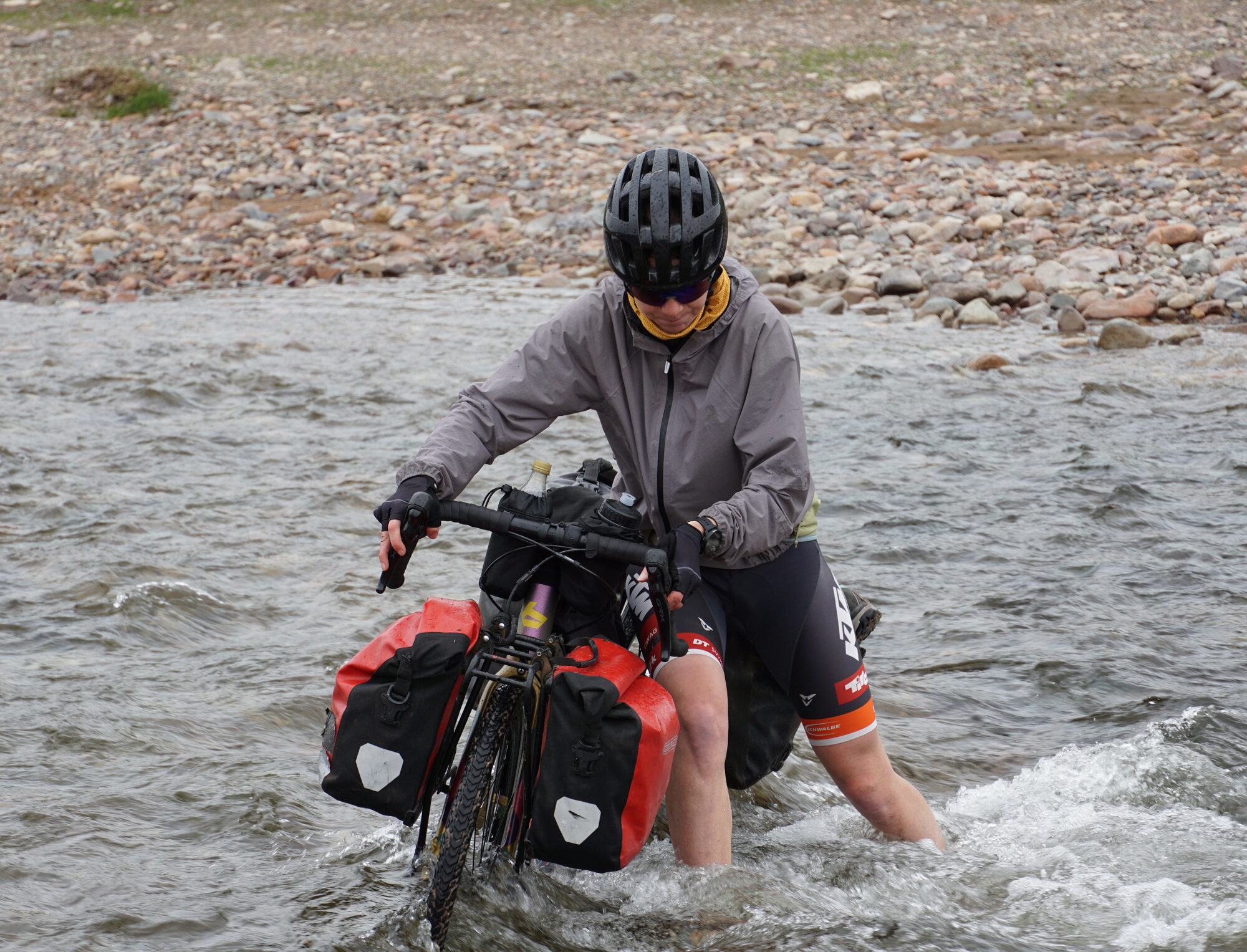
Unexpectedly, we're confronted by a deep river. Not again! But this one isn't as powerful as the previous ones. We've learned from our mistakes and first carry the panniers across, followed by the bikes, making sure the hubs don't get flooded. While we're busy manoeuvring all our belongings through the river, some cows inspect our bags and bikes already waiting on the other bank.
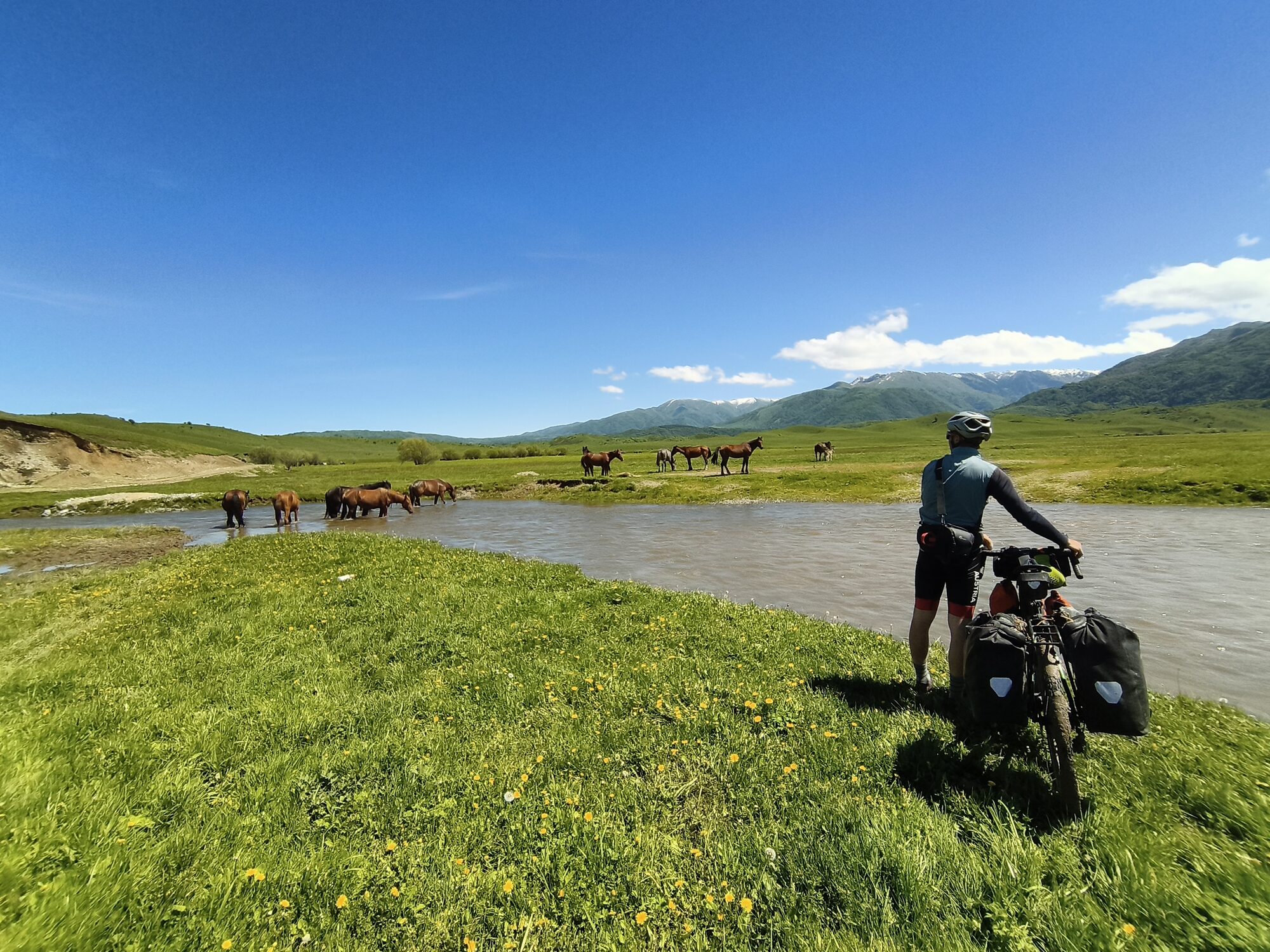
On we go, watching herds of horses moving across the meadows and enjoying the landscape. Suddenly, the idyll is interrupted by the sight of another river. We know that if there isn't a bridge here, we'll have to backtrack the last two days. Carrying the bikes through the current here is impossible. We ride upstream, hoping that the vehicle tracks on the ground will eventually lead to a bridge. And sure enough, after a few hundred metres, we see a proper bridge. Rarely have we been so happy at the sight of a bridge.
An hour later, we reach Lepsy. From a distance, we can already see a gigantic building complex, which turns out to be a brand-new Olympic centre. Outside, children are training for cross-country skiing on roller skis. With all the gravel on the asphalt, that's twice as impressive. The woman who runs the minimarket and café/restaurant kindly invites us for a meal. She tells us about studying in Beijing and that the last cyclists to pass through here were two Frenchmen ten years ago. At the last Winter Olympics, a Kazakh woman from this village won a silver medal in speed skating, which is one of the reasons why there's now a new Olympic centre here.
We ride a little further and are pretty struck by the gap between rich and poor, and between the countryside and the cities.
## Day 17: Lake Alaköl
Only two more days to the Chinese border. In theory, today should be mostly downhill, but we really don't notice any of that. The Kazakhs are professionals when it comes to including every possible hill when building a road. It's constantly up and down. And when there finally is an opportunity to build a road with a moderate gradient, it's so flat that you still have to pedal while "riding downhill".
"Warning: 20 km construction zone," says a sign, suggesting that the next section is going to be painful. We don't actually see any construction, but the road could desperately use a major renovation.
We fight our way to a small village, where we have an ice cream and try to chat with the locals. I forget my cycling gloves, which a young boy kindly rides after me to return.
In the evening, we reach Lake Alaköl. We had actually planned to stay in a hotel there, but the village is one huge construction site and we can't find anywhere to stay. So, once again, we pitch the tent.
In summer, Kazakhs like to come here on holiday. The black volcanic rock on the beach is said to have healing properties. It's also a saltwater lake and you can't see the other side. It feels like being by the sea.
It's Thursday and there's only one day left to the border. We decide not to arrive in Dostyk on Friday because we're not sure whether we'd still be able to cross the border in the afternoon. The border is closed on Saturday and Sunday. So we spend the next two days by the lake, wash our clothes and, for the first time, can just be lazy without having to make any big plans. Finally, a bit of peace for our minds too!
## Day 18: Lake Alaköl - Dostyk
With a tailwind, we cruise the last 100 km to the border at full speed. After 2.5 hours, we're there! What a pleasure. There are mainly trucks on the road, but they always greet us and give us plenty of space when overtaking.
Before looking for a suitable place to sleep, we still have to go into the village to find out when the border bus leaves and how much it costs. I get the information from two locals, who immediately start chatting with me and try to arrange their hotel as accommodation for us. I decline, mainly because Vanessa is waiting for me a little further away.
We're having a snack on a bench in the shade when the two men show up again and want to take us to their accommodation. By now, we've got used to the bad Google Translate translations, but it's still unclear what exactly they're offering us.
We give up and follow one of the men towards the train station. It turns out that he's inviting us to his family's party shack, which has a kitchen, running water and sleeping bunks. We happily accept the offer and are glad we don't have to look for somewhere to pitch our tent. It's perfect for us! Only 50 metres from the bus station.
In the evening, we go out for Kazakh skewers one last time and are already a little nervous about how entering China is going to go. We've heard plenty of wild stories and are curious whether we'll really just be given a 30-day tourist visa upon entering the country. At that point, we had no idea just how intense the border crossing would actually be.